
Program Director
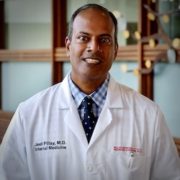
Jeet Pillay, M.D., F.A.C.P.
Assistant Program Director

Batoul Dagher, DO
Graduate Medical Education Manager

Mary Muma
Program Coordinator
Kara Thornton
House Staff
PGY 3
Robert Woodruff, DO – Chief Resident – Campbell University School of Osteopathic Medicine
Arman Astani, MD – St. George’s University School of Medicine
Darnell Solomon, MD – Trinity School of Medicine
Marcel Mio, DO – Lake Erie College of Osteopathic Medicine, Erie
Tyler Sells, DO – Lincoln Memorial University DeBusk College of Osteopathic Medicine
PGY 2
Ali Barakat, MD – Medical University, Sofia Faculty of Medicine
Fady Safwat, MD – Washington University of Health and Sciences
Jonnathan Cazares, MD – Universidad Autónoma Metropolitana Unidad Xochimilco
Khaled Elnaggar, MD – St. George’s University School of Medicine
Mirela Yanakieva, MD – Medical University, Sofia Faculty of Medicine
Mohammad Darwish, MD – St. George’s University School of Medicine
Pablo Rabade, MD – Universidad de Navarra Facultad de Medicina
Sandra Safwat, MD – Washington University of Health and Sciences
PGY 1
Ali Hok, MD – Poznan University of Medical Sciences Center for Medical Education In English
Carlos Roble, MD – Drexel University College of Medicine
Damian Pajor, MD – Jagiellonian University Medical College
Dana Sarrafi, MD – St. George’s University School of Medicine
Hassan Abbas, MD – University College Dublin School of Medicine and Medical Science
Marina Mekhaeil, MD – NUI Galway School of Medicine
Salima Meskine, MD – St. George’s University School of Medicine
Shawn Pandher, MD – Royal College of Surgeons in Ireland School of Medicine
A FOCUS ON QUALITY EDUCATION
During your three year residency, you will develop clinical skills, medical knowledge, and advance professionally and personally.
Our Internal Medicine Program strives to create an atmosphere of education, respect, and friendship. Residents work and play as part of a team. They understand that hard work and long hours are taxing, and often go out of their way to help others out. Truly, our attending staff, GME, and all hospital employees set the example for this welcoming atmosphere. You will make friends from all areas of the hospital, including the housekeeping staff, nurses and fellow residents.
GRADUATE MEDICAL EDUCATION
As a student, an essential aspect of future residency training is the quality of the GME office. Our seasoned GME staff provides assistance for letters of recommendation, application requests, documentation for licensure, malpractice insurance, support for fellowships and much more. We have the resources and personnel to meet residents’ needs in a competent, timely and efficient manner.
CLINICAL ROTATIONS THROUGHOUT THE THREE YEAR RESIDENCY
Resident inpatient rotation teams are made up of an attending physician/ faculty, residents and medical students. Specialty Service rotations offer an intimate training experience with the resident working directly with the attending physician/ faculty. Training occurs both in the hospital and private Physician Office setting.
Core Rotations: Surgery, Internal Medicine, GI, Hem Onc, ICU, Infectious Disease, Endocrinology, Women’s Health, Nephrology, Neurology, Cardiology, Pulmonology and Rheumatology
Elective Rotations: Dermatology, Geriatrics, Allergy, Nephrology, Rheumatology, Inpatient Internal Medicine, and Ophthalmology.
BLOCK SCHEDULE
The rotation assignments do not change year to year as the follow the curriculum set forth by the ACGME standards. MA, MB, MC, MD refer to the medicine teaching service teams and N is night medicine block.
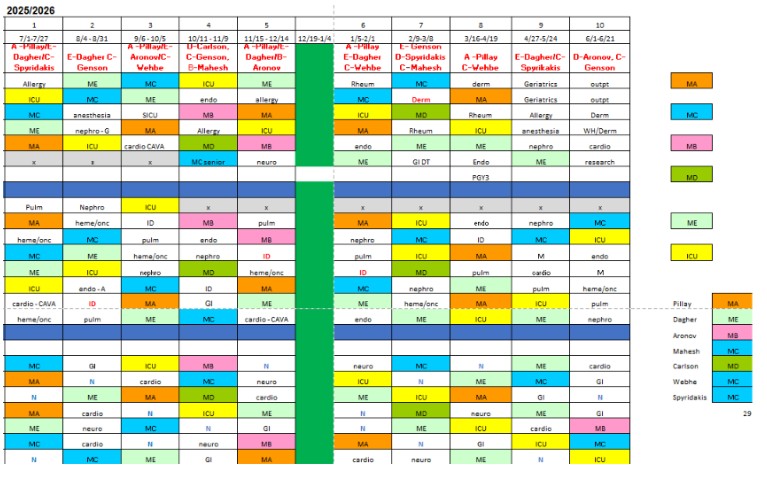
4+1 SCHEDULE
The four plus one system represents an innovative scheduling system that maximizes resident clinical learning while respecting work life balance and wellness. The system is claimed by residents and attendings at large University programs such as Tulane and Harvard. The system has also received praise from our own program residents. .
What is the “4”?
Four represents the traditional four week rotation. For four consecutive weeks, you will participate in traditional rotations, including electives. These weeks are free of interruptions, including continuity clinic and didactic lectures. The rounding team remains together to enable uninterrupted inpatient care. This helps to foster a “team” environment and sense of camaraderie.
During these blocks, we conduct a resident run, attending supervised, Noon Report. The Noon Report is attended by all in-house residents and most on out-patient rotations. This one hour conference features an intern presenting a patient from the floor or a particularly interesting case, followed by a Chief Resident led discussion.
What is the “+1”?
The one is perhaps the residents’ favorite part of the system. During this week, all residents are free from hospital & floor duties. Yes, no wards. Each morning at 07:30, lectures begin from all specialties, with each hour as a different topic. Lecturers vary from attending internists, in-house specialists, specialists from DMC main, or other regional experts. These mornings also house MKSAP review sessions and occasionally workshops.
Afternoons are spent in continuity clinics. Uniquely, Huron Valley residents have a low attending-to-resident ratio in private clinic settings. This allows for considerably more one-on-one teaching, without compromising continuity. It also allows residents interested in private practice to learn about the business of medicine and running a practice. Our residents see considerably more patients in their clinics, and have low “no show” rates.
The “+1” weeks offer intensive didactics, immersion in clinic, and a refreshing break from often grueling floors. Although brand new to Huron Valley, the “4+1” has been a great success.
What else about the “4+1”?
Because the “+1″s constitute a total of ten weeks, HVSH IM residents have only ten, four week, rotations per year. This is at the expense of additional electives, but so far, the benefits have far outweighed this cost. Additionally, because the number of blocks is decreased, the number of residents per team increases, again fostering an excellent rounding atmosphere in a small internal medicine program.
Unlike its allopathic counterparts, the HVSH “4+1 System” has only one cohort of residents. This means that all internal medicine residents are on the “+1” week together, and the floors are staffed solely by attending physicians, physicians assistants, and traditional rotating interns based at HVSH.
What will my schedule look like?
July 1st will always begin a four week rotation block. The following week will be the “+1”. Effectively, it is a five week scheduling scheme x 10. The final two weeks are offered as an elective. Although medicine residents typically begin residency on a medicine service, there is no particular order to the ten blocks.
During the “+1”, you will arrive for lecture at 7:30 am, where four lectures follow (with interspersed breaks). Residents will break to get lunch, and eat together over the Noon Report. After the case finishes, residents drive to their continuity clinics (typically five miles or less from the hospital). The day is finished when all clinic patients are seen. For scheduling purposes, Fridays are reversed.
CLINICS
Resident continuity clinics are in community private practice Internal Medicine Offices in the Commerce, Novi/, West Bloomfield, and Walled Lake Communities. Residents are assigned to a physician’s office for their three year training period. Residents participate in clinics during the fifth week of the rotation for a 1/2 day each day, 5 days of the week.
EVALUATIONS
Residents are evaluated by faculty at the completion of each rotation. Evaluations are completed by faculty in New Innovations and must be reviewed and signed off on by residents.
All Residents are evaluated on a semi-annual basis by the Clinical Competency Committee (CCC). The CCC is composed of members of the program faculty. Residents are also evaluated on a monthly basis, rotation evaluations as well as direct observation feedback and peer feedback is provided to Residents.
Residents are also given the opportunity to evaluate faculty and their rotation experience. Service evaluations are completed in New Innovations and are anonymous to faculty